Research — Eisaku Umeda
Research
1. How my research began, and my first published paper
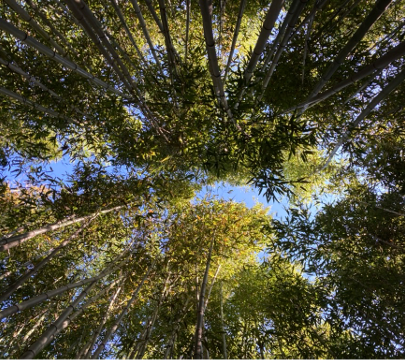
My interest lies in the evolution of life-history strategies. A life-history strategy is the combination of reproductive and survival behaviors that an organism adopts to maximize its fitness in a particular environment (Buss & Schmitt, 2019) — for instance, when, and how many times in its life, a plant flowers. Cherry trees bloom every year, yet when you step into a bamboo grove you almost never find one in flower. I am fascinated by how such traits — when an organism grows and when it reproduces — came to be so diverse across living things, whatever their size or kind.
It began with a paper by my advisor that I happened to read: a theoretical study showing that the number of years bamboos wait before flowering grows longer as their rhizomes grow longer. Bamboos follow a monocarpic, perennial life history. After germinating from seed, they spend decades extending underground branches to produce clones (the shoots we call takenoko), until at last they flower and die all at once. This time from germination to flowering is species-specific, ranging from 3 to 120 years, and across Asia it shows a latitudinal gradient, lengthening from the tropics toward the temperate zone. The paper argued that this gradient might be generated by differences in rhizome structure.
In fact, while East Asian countries such as Japan, China, and Korea have bamboo groves, Indonesia, India, and Sri Lanka do not. The bamboos of tropical Asia produce and place their clones close to the parent — a consequence of rhizome structure. Temperate bamboos have, species by species, thin and long rhizomes, while tropical ones have thick and short rhizomes. Tachiki et al. (2015, J. Ecol.) showed not only that the latitudinal gradient in flowering cycles parallels the tropical-to-temperate change in rhizome structure, but that this difference in rhizome structure may itself be what creates the gradient.
This was the first mathematical-biology paper I had ever read, and it was unlike anything in my world until then. When the rhizome is long, the distance between clones grows; the competition among clones during the waiting period before flowering is eased; and so clonal growth becomes more efficient and flowering is delayed even further. In high school I belonged to the literature club, and — admiring the science fiction of Project Itoh and Toh EnJoe — I wrote my own (would-be) speculative stories; to me, this endeavor was electrifying. With the tool of mathematics, one could pursue truth like a character in a science-fiction novel. That was the conviction I drew from Tachiki et al. (2015, J. Ecol.). I want to do this for real! — that is what I thought.
At first I simply could not reproduce the earlier study's results, and as I searched for the cause I came to see that the key lay in asymmetric competition. In competition for light, taller individuals monopolize the light and shade out shorter ones. This asymmetry — where the advantage runs in only one direction — had been assumed implicitly in the earlier work, but in my model it had to be built in explicitly. The analysis that confronts this assumption head-on is the paper I co-authored with Prof. Tachiki, Tachiki & Umeda (2026). We showed that asymmetric competition between seed-derived offspring and offspring produced clonally through rhizomes can drive the evolution of extraordinarily long flowering times in monocarpic perennial plants.
I am now working on my second study.
References
- Buss, D., & Schmitt, D. (2019). Mate preferences and their behavioral manifestations. Annual Review of Psychology, 70(1), 77–110.
- Tachiki, Y., Makita, A., Suyama, Y., & Satake, A. (2015). A spatially explicit model for flowering time in bamboos: long rhizomes drive the evolution of delayed flowering. Journal of Ecology, 103(3), 585–593.
- Tachiki, Y., & Umeda, E. (2026). Asymmetric competitions between seedling and clonal ramet promote the evolution of extraordinary long flowering time in monocarpic perennial plants. Plant Species Biology, 41(1), e70039. doi:10.1111/1442-1984.70039